Body of U.S. soldier recovered in Morocco after cliff fall; second service member still missing
A Moroccan military search team pulled the remains of 1st Lt. Kendrick Lamont Key Jr. from the Atlantic surf on May 9, one week after the 27-year-old Army officer and a fellow soldier plummeted off a cliff during an off-duty hike near Morocco's Cap Draa Training Area. The second American service member has not been found.
Key, an Air Defense Artillery officer from Richmond, Virginia, was assigned to Charlie Battery, 5th Battalion, 4th Air Defense Artillery Regiment, 10th Army Air and Missile Defense Command. He and the unnamed soldier had been in Morocco for the African Lion multinational military exercise when they went over the cliff's edge around 9 p.m. on May 2, the Washington Times reported, dropping into the ocean below.
U.S. Army Europe and Africa confirmed the recovery in a statement:
"A Moroccan military search team found the Soldier in the water along the shoreline at approximately 8:55 a.m. local time May 9, within roughly one mile of where both Soldiers reportedly entered the ocean."
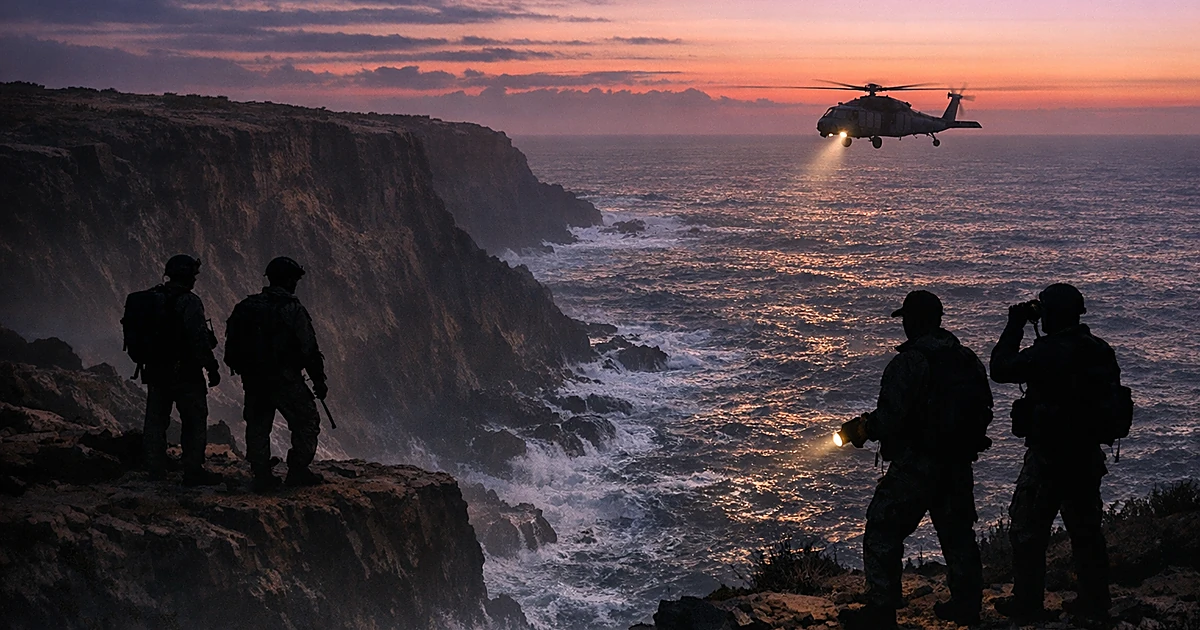
That single mile of coastline became the focal point of a massive multinational operation. More than 600 personnel from the United States, Morocco, and partner nations launched the search, deploying frigates, smaller vessels, helicopters, and drones. By the eighth day, teams had covered more than 12,000 square kilometers of sea and shore.
None of it has yet located the second soldier.
A young officer's short career
Key began his military career as an officer candidate in 2023 and rose to Air Defense Artillery officer by 2024. Before joining the Army, he earned a Bachelor of Science in marketing from Methodist University in North Carolina, with minors in international business, entrepreneurship, and business administration.
Brig. Gen. Curtis King acknowledged the loss publicly. Fox News quoted King saying: "Today, we mourn the loss of 1st Lt. Kendrick Key, whose remains were recovered in Morocco."
The Army has not publicly identified the second missing soldier. No official explanation has been given for what caused both men to go over the cliff during their recreational hike, and the military has not said whether the African Lion exercise was formally suspended or simply halted in practice after the incident. What is clear is that the disappearance, as one account put it, "brought it to a screeching halt."
African Lion's history, and its risks
African Lion has run since 2004 as a flagship multinational exercise, drawing participants from more than 30 nations. This year's iteration involved over 7,000 military personnel before the May 2 incident shut things down. U.S. personnel stayed behind after the exercise to continue the search for the missing soldier, AP News reported.
The exercise is not without precedent for tragedy. In 2012, two Marines were killed and two others injured when their helicopter went down during African Lion operations. That earlier loss underscores a reality the military knows well: training environments carry real danger, and the risks do not end when the formal drills do.
This time, the fatal incident happened not during a live-fire drill or an airborne insertion but on a hike, off-duty, after hours. That distinction matters. It raises questions about safety protocols governing recreational activity in rugged, unfamiliar terrain during overseas deployments. Were soldiers briefed on the cliff hazards near Cap Draa? Were they hiking in daylight or darkness? The 9 p.m. time stamp suggests the latter, though the military has offered no detail on conditions.
Americans following this story may recall other tense overseas disappearances that gripped the nation before resolution arrived. The difference here is that only half the story has ended.
The search continues
More than 600 searchers remain committed to finding the second soldier. The operation spans a vast stretch of Morocco's Atlantic coastline, an area where strong currents and rocky terrain complicate recovery efforts. Frigates, helicopters, drones, and smaller vessels have all been deployed, yet eight days of intensive coverage across 12,000-plus square kilometers of sea and shore have produced only one recovery.
Newsmax confirmed that the multinational search effort continues, with U.S., Moroccan, and partner forces still engaged. The scale of the operation reflects both the seriousness with which the military treats its obligation to recover fallen service members and the difficulty of the environment.
The identity of the second soldier has not been released, and the Army has given no public timeline for how long the search will continue. Families, unit members, and the broader military community are left waiting.
Incidents like this remind Americans that service members face danger not only in combat but in the training and downtime that surround it. Even routine moments near military installations can turn dangerous without warning.
What remains unanswered
Just The News noted that Key and the other soldier fell from the cliff during a recreational hike tied to military training downtime. But the military has released almost no detail about the circumstances of the fall itself. Was the trail marked? Were other soldiers present? Did anyone witness the fall in real time, or were the two men reported missing only after they failed to return?
These are not idle questions. They go to the heart of whether the command structure took adequate precautions for troops operating in unfamiliar and potentially hazardous terrain overseas. The Army owes answers, to Key's family, to the family of the soldier still missing, and to the public that entrusts young Americans to military leadership.
The broader pattern is worth watching. When serious incidents involving American lives abroad demand accountability, the public deserves transparency, not silence wrapped in institutional caution.
Key was 27. He had been an officer for roughly two years. He came from Richmond, studied marketing, and chose to serve his country. Now his family is planning a funeral while another family waits for news that may never come.
The military's job now is simple: find the second soldier, explain what happened on that cliff, and make sure no one else walks the same path without knowing what's at the edge.
Troops who volunteer to train in remote corners of the world deserve leadership that accounts for every risk, not just the ones on the exercise schedule.