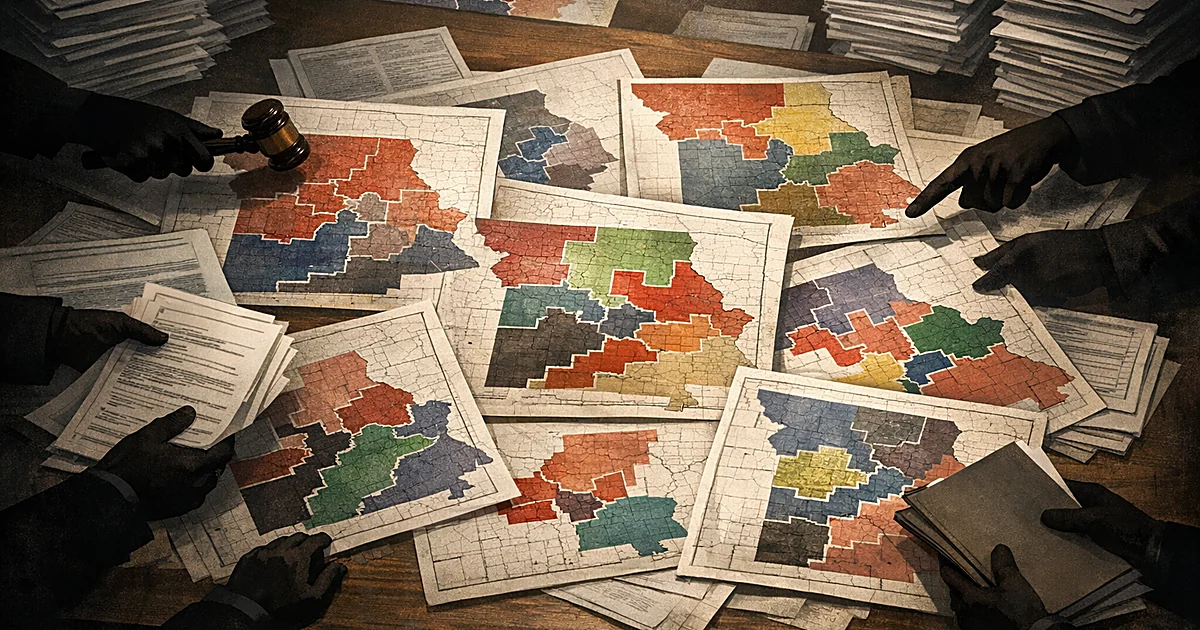
Supreme Court takes up Missouri redistricting fight for a third time as ballots pile up
Justice Brett Kavanaugh accepted yet another emergency appeal in Missouri's tangled congressional map dispute, the third round at the high court, even as county clerks say ballots are already printed and voters have already cast them.
The move came Tuesday night after the Eighth U.S. Circuit Court of Appeals, based in St. Louis, ruled Monday in favor of a 2025 redistricting map that would redraw Missouri's congressional lines to favor Republicans. Opponents of the map, led by the Democratic-aligned group People Not Politicians, raced to the Supreme Court within hours, asking Kavanaugh to step in again. He did, directing supporters of the new map to file their response by Wednesday at 2 p.m. ET.
It is the third time the justices have been dragged into a redistricting fight that has bounced between state and federal courts for months, with dueling rulings, a contempt threat against Missouri's secretary of state, and an election calendar that has already overtaken the legal proceedings.
300,000 signatures, one secretary of state, and a map that kept moving
The dispute traces back to a 2025 redistricting map that would expand the Kansas City, area 5th Congressional District into more Republican-leaning rural territory. If the map holds, Republicans stand to pick up an additional U.S. House seat in the 2026 midterms. People Not Politicians gathered roughly 300,000 signatures on a petition arguing that Missouri's constitution required the map to go before voters in a referendum.
Missouri Secretary of State Denny Hoskins rejected that petition. Rather than place the map on the ballot for a 2026 vote, Hoskins used the new lines to set congressional districts for the state's primary elections. Republican candidates won their primaries under those redrawn boundaries.
The Missouri Supreme Court disagreed with Hoskins. It ruled that the 2025 map could not take effect "unless and until approved by the voters at the November 2026 general election." The state high court went further, threatening Hoskins with contempt for pressing ahead with the new lines.
Hoskins appealed that ruling to the U.S. Supreme Court. On Sept. 4, Kavanaugh, who handles emergency requests from Missouri as the circuit justice, declined to hear the secretary of state's case. That appeared to settle the matter. It did not.
A federal judge overruled the state court, then the Supreme Court stepped in twice
Republican candidates who had already won primaries under the 2025 map brought a separate federal lawsuit. Eighth Circuit Judge Stephen R. Clark sided with them, issuing an order that required the 2025 maps be used for this year's elections. Clark's ruling directly contradicted the Missouri Supreme Court's order blocking those same maps.
People Not Politicians went back to the Supreme Court. The justices responded with an unsigned order blocking Clark's ruling until the Eighth Circuit issued a formal decision. That was round two.
The Eighth Circuit fast-tracked the case and, on Monday, ruled in favor of the 2025 map. Within hours, opponents filed their emergency appeal, setting up round three. Kavanaugh's willingness to accept the filing signals the court has not finished with Missouri's maps, even as the election machinery grinds forward without waiting for a final answer.
Kavanaugh's role as the pivotal voice in this dispute has drawn attention beyond Missouri. His recent decisions on election-related cases have placed him at the center of several high-profile rulings where timing and procedure intersected with partisan stakes.
County clerks say the calendar has already decided the question
While the courts traded orders, Missouri's county election officials moved ahead. The Missouri Association of County Clerks and Election Authorities filed its own appeal, arguing the state simply does not have enough time to produce new ballots. The association announced it will not use the 2025 map for November's elections regardless of what the courts decide next.
Richard von Glahn, director of People Not Politicians, put the practical reality bluntly in a statement:
"Ballots have been printed, and Missourians have already voted. Thousands more will vote before this order seeks to take effect. Officials should stop wasting taxpayers' money on pointless legal action and instead focus on administering our elections."
The group's position is straightforward: the Missouri Supreme Court already ruled against the map, voters have already started casting ballots under the old lines, and no court order can unring that bell. Breitbart reported that Kavanaugh personally issued the earlier decision rejecting Missouri's emergency appeal without explanation, and that the rejected map was backed by President Trump.
Supporters of the 2025 map counter that Republican candidates won their primaries under those new district lines. Forcing a general election under different boundaries, they argue, would mean voters face one set of districts in the primary and a different set in November, an outcome that undermines the coherence of the entire election cycle.
That tension, between legal process and election logistics, sits at the heart of every emergency filing in this case. Courts can issue orders. Printers cannot unprint ballots.
Kavanaugh's growing footprint on election disputes
Kavanaugh's centrality in this fight reflects a broader pattern. As circuit justice for Missouri, he is the gatekeeper for emergency appeals from the state. He has now touched this case at least three times: declining Hoskins' initial request, participating in the unsigned order that blocked Judge Clark's ruling, and accepting the latest emergency appeal Tuesday night.
His decisions in other recent cases have carried similar weight. His opinion in a major birthright citizenship ruling gave Republicans a legislative framework to work with, and his handling of mail-ballot disputes has drawn both praise and criticism from within the conservative movement.
Just The News reported that Kavanaugh acted as the deciding judicial authority in turning down the earlier emergency redistricting appeal, underscoring his position as the single justice whose procedural calls have shaped the trajectory of the entire case.
The political stakes are not abstract. The 2025 map would give Republicans a pickup opportunity in a state they already dominate at the statewide level but where Democrats have held the Kansas City, area House seat. One additional GOP seat heading into the 2026 midterms could matter in a narrowly divided House.
Critics of the court's involvement, particularly on the left, have seized on cases like this to argue the Supreme Court has become a partisan actor. Some Democratic figures have used redistricting fights to renew calls for structural changes to the judiciary, though those proposals have gained little traction in Congress.
Open questions the courts have not answered
Several practical unknowns remain. The Supreme Court's acceptance of the emergency appeal does not automatically reinstate the stay on the 2025 map, that is a separate determination the justices may or may not make. How many Missourians have already voted under the old maps is unclear. And the Missouri Supreme Court's contempt threat against Secretary of State Hoskins hangs unresolved in the background.
What is clear is that the legal fight has outrun the election calendar. County clerks have printed ballots. Voters have filled them out. The Supreme Court's recent willingness to intervene in election mechanics close to voting deadlines has become a recurring feature of the current term, and Missouri's case is now the sharpest example.
Wednesday's 2 p.m. deadline for map supporters to respond will determine how quickly the justices move. But even a rapid ruling may arrive after thousands more ballots have been cast, making any map change an exercise in legal formality rather than practical governance.
When courts spend more time fighting over which lines to use than voters spend filling in the bubbles, the system is not serving the people it was built for.