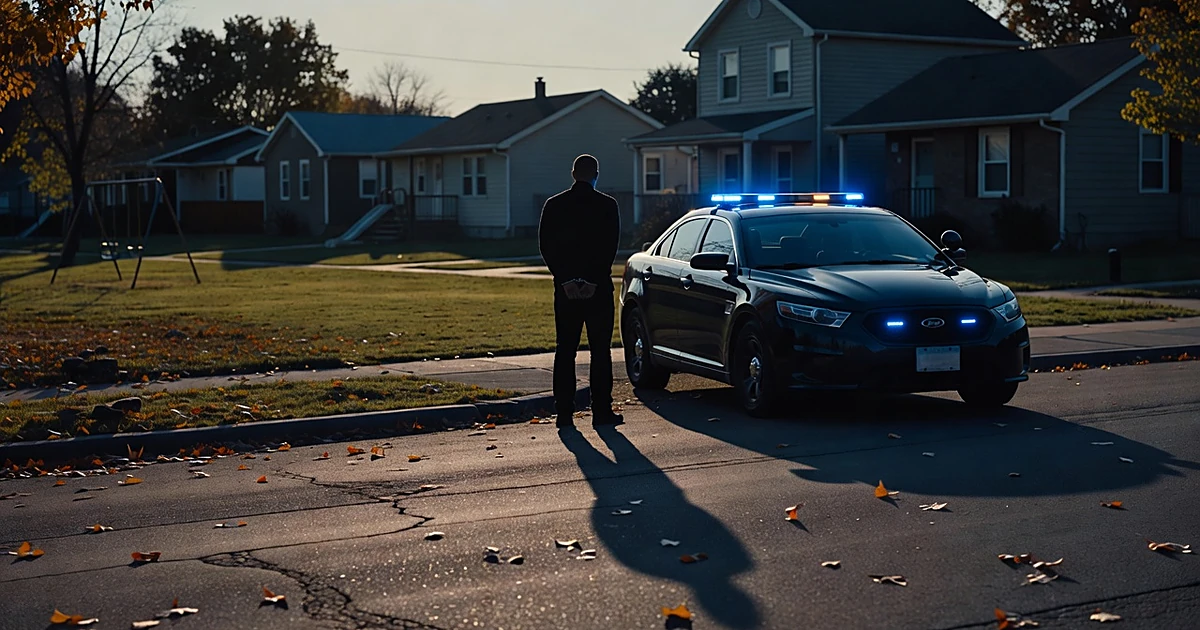
Arkansas judge dismisses murder charge against father who killed daughter's accused abuser
A Special Circuit Court judge in Arkansas threw out the second-degree murder charge against Aaron Spencer on Thursday, ruling that law enforcement misconduct, including the loss of a dash camera memory card that may have captured the fatal shooting, was severe enough to warrant dismissal of the case entirely.
Spencer, who shot and killed 67-year-old Michael Fosler on Oct. 8, 2024, after finding his then-13-year-old daughter in the passenger seat of Fosler's vehicle, had pleaded not guilty. Fosler had already been charged with grooming and abusing the girl before the night he was killed.
The dismissal came just weeks before Spencer was set to stand trial. It also came months after he won the Republican primary for Lonoke County sheriff, and, as the New York Post reported, he is expected to win the general election in the county east of Little Rock.
What happened the night of Oct. 8
Court documents paint a grim picture. Spencer woke around 1 a.m. to discover his daughter had vanished from the family home. He located her in the passenger seat of a vehicle Fosler was driving. Spencer forced the truck off the road and, according to prosecutors, shot Fosler.
Prosecutors argued Spencer planned the killing and could have called police during the car chase instead of taking matters into his own hands. Spencer maintained a different account: he acted in the moment to protect his child from a man already facing criminal charges for sexually abusing her.
The case split public opinion along a fault line familiar to anyone who has watched the justice system struggle with crimes against children. On one side, the legal principle that citizens cannot administer lethal force outside the bounds of self-defense or imminent threat. On the other, a father's claim that the system had already failed his daughter once and was failing her again that night.
Lost evidence, dismissed case
What ultimately ended the prosecution was not a jury verdict or a plea deal. It was the conduct of law enforcement itself. A dash camera memory card, one that may have recorded the fatal encounter, went missing. Special Circuit Court Judge Ralph Wilson Jr. found the misconduct disqualifying.
"The court finds that conduct by law enforcement was so egregious that dismissal of this case is warranted."
Judge Wilson didn't hold back. The ruling placed the blame squarely on the agencies responsible for preserving evidence, not on the defendant. When the state loses the one piece of physical evidence that could have shown a jury exactly what happened, the state forfeits its ability to prosecute. That is a basic principle of due process, and it held here.
The ruling raises hard questions about institutional competence. Which law enforcement agency lost the memory card? Was it negligence or something worse? The court record, at least as publicly available, does not answer those questions. But the judge's language, "so egregious", suggests he saw more than a clerical error.
Across the country, cases involving prosecutors bringing charges in high-profile shooting cases continue to test public confidence in how the justice system handles lethal force. The Spencer case adds another chapter.
A father's defense
Spencer has been consistent from the start. In a statement, he framed the case in terms millions of parents would instinctively understand.
"I'm the father who acted to protect his daughter when the system failed."
His attorney, Erin Cassinelli, issued a statement to the Associated Press that went further, calling the prosecution itself a form of harm to the family.
"No member of this family should ever again be forced to walk into a courtroom and relive this horror. This father should have never been charged for protecting his child."
Cassinelli's argument carries weight precisely because of the underlying facts. Fosler was not a stranger accused after the fact. He had already been charged with grooming and abusing Spencer's daughter before the night of Oct. 8. The system knew. It had acted, partially. And then a 67-year-old man was driving away with a 13-year-old girl in the middle of the night.
That timeline matters. It is not a case where someone took the law into their own hands based on rumor or suspicion. The criminal justice system had already identified Fosler as an accused predator. Yet on the night in question, it was a father, not police, who found his daughter in that vehicle.
Sheriff nominee with a mandate
Spencer's political trajectory has run parallel to his legal ordeal. He won the Republican primary for Lonoke County sheriff in March, even while facing a murder charge. The New York Times reported he is expected to win the general election. Voters in Lonoke County appear to have made their judgment clear, well before the judge made his.
That a man under indictment for second-degree murder could win a law enforcement primary tells you something about how the community views the case. It is not an endorsement of vigilante justice. It is a verdict on the gap between what the system promises and what it delivers, especially when children are involved.
The pattern of felony charges being dropped against public figures has drawn scrutiny in other contexts. But the Spencer case stands apart because the dismissal rested on prosecutorial failure, not political negotiation.
Spencer's daughter, now 14, was not named in any public reporting. She is the person at the center of this case who never asked to be there, abused by a man decades her senior, then forced to watch her father face a murder charge for intervening.
The system's failures, compounded
Consider the sequence. A man is charged with grooming and sexually abusing a child. That same man, while those charges are pending, drives off with the child in the middle of the night. The father catches them. The father uses lethal force. The state charges the father with murder. Then the state loses the key piece of evidence.
At every step, an institution failed. The criminal justice system failed to keep Fosler away from the girl. Law enforcement failed to preserve the evidence that might have resolved the case one way or another. And prosecutors pursued a murder charge against a father whose daughter was in the car with her accused abuser at 1 a.m.
None of this means the law should look the other way when someone kills another person outside of clear self-defense. Prosecutors had a legitimate question to raise: could Spencer have called 911 during the chase? That question deserved an answer. But the state's own misconduct ensured no jury will ever weigh it.
When public officials face felony charges, the expectation is that the process will be handled with competence and transparency. The Spencer case met neither standard on the prosecution side.
What remains unanswered
The dismissal closes the criminal case, but it does not close every question. No public accounting has identified which agency lost the dash camera memory card, or how. No explanation has surfaced for why a man facing child abuse charges was apparently unsupervised and in contact with his alleged victim.
Spencer will likely become Lonoke County's next sheriff. He will run the same kind of agency that lost the evidence in his own case. Whether that irony produces reform or simply fades into local memory is an open question.
In an era when federal criminal charges tied to law enforcement regularly make national headlines, the Spencer case stands out for a different reason. The defendant was not a rogue actor or a political agitator. He was a father who woke up at 1 a.m., found his child gone, and did what the system had already failed to do.
When the institutions meant to protect children cannot manage to keep an accused abuser away from his victim, or even preserve the evidence afterward, it is hard to fault the man who stepped into the gap. The court, at least, could not.